
NIGERIA TV INFO — GLOBAL ECONOMY & TECHNOLOGY
EU Recovery Fund Drives AI Farming Revolution But Exposes Economic Gaps
Across vast olive groves and vineyards in Spain, a quiet technological revolution is unfolding as sensors buried in soil and drones flying overhead collect real-time agricultural data. The information is feeding artificial intelligence systems designed to help farmers monitor crops, manage water use, and improve yields with greater precision.
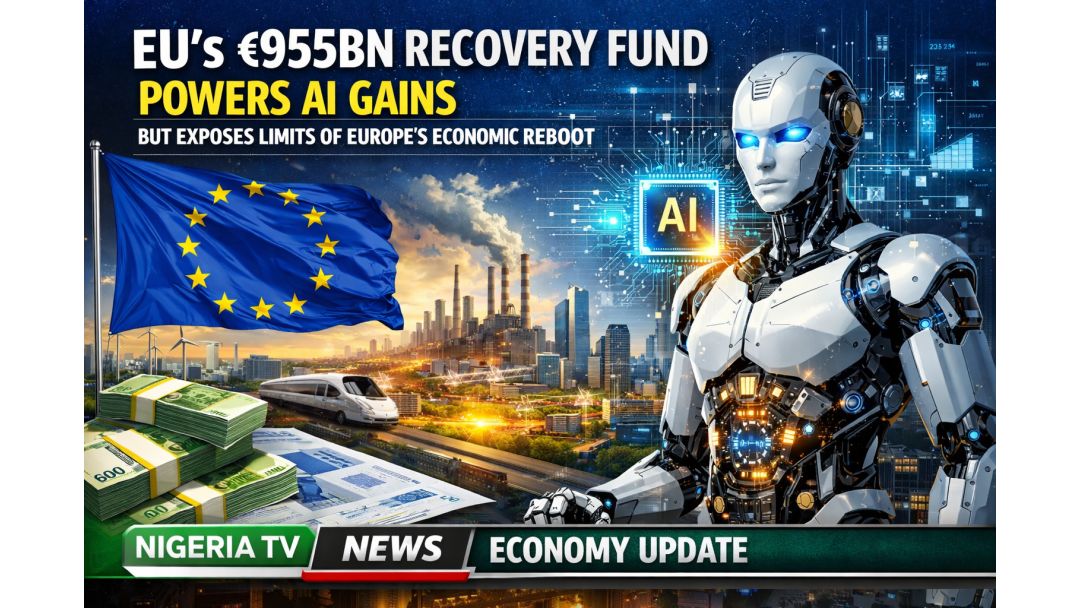
The innovation push is being funded through the European Union’s historic €955 billion “Next Generation” recovery programme, the bloc’s largest economic stimulus effort since the post-World War II Marshall Plan. The programme, launched in the aftermath of the COVID-19 pandemic, aims to modernise Europe’s economy by accelerating digitalisation and decarbonisation across key sectors — including agriculture.
The Spanish farming project highlights how recovery funds are transforming traditional industries through advanced technology. AI-powered analysis of soil health, weather patterns, and crop performance allows farmers to reduce waste, optimise fertiliser use, and cut emissions, aligning with the EU’s climate goals.
However, the project also reveals deeper structural challenges facing Europe’s economic reboot.
According to Juan Francisco Delgado, a coordinator involved in the agricultural AI initiative, the recovery funds succeeded in building digital foundations.
“The funds left us with data infrastructure, common governance and teams capable of operating AI at scale,” he said.
But sustainability beyond EU support remains uncertain.
“What they haven’t left us with is a business model,” Delgado added, explaining that his team is now scrambling to develop financial plans to maintain data platforms, upgrade hardware, and hire skilled workers once the funding cycle ends.
As the programme nears its final payout deadlines, concerns are growing across Europe over skills shortages, administrative bottlenecks, and unclear long-term funding frameworks. Experts warn that while the stimulus has sparked innovation, its ability to create permanent economic transformation remains in question.
The recovery fund was originally agreed in 2020 when EU economies faced record GDP contractions due to pandemic lockdowns. Beyond economic stabilisation, leaders envisioned it as a once-in-a-generation opportunity to reshape Europe’s growth model around technology and sustainability.
The experience in Spain’s farmlands now reflects both sides of that ambition: rapid digital progress powered by public investment — and the looming challenge of turning innovation into self-sustaining economic value.
Comments